

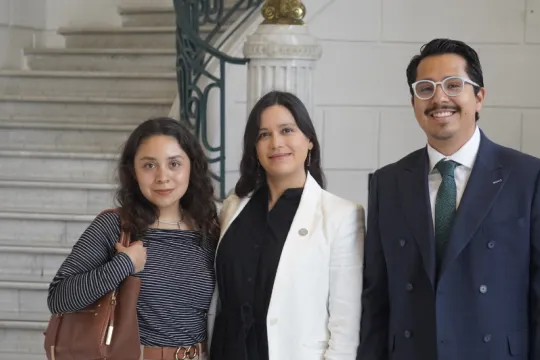
Members of the León Urban Lab and WRI Mexico at the First International Congress on Participatory and Resilient Urbanism. © WRI Mexico
Aiming to expand the reach of the Transformative Urban Coalitions (TUC) project and contribute to the replicability of urban labs as a model for consensus-based decision-making that promotes climate action and social justice, WRI Mexico and lab members have participated in various spaces for dialogue, reflection and collective learning. Presenting the project at conferences and seminars allows project participants to share their four-year experience in León, Guanajuato, and Naucalpan, State of Mexico, as well as the methodologies, findings and lessons learned that will allow other cities to adapt the model and spark local processes of innovation, governance and urban transformation based on an inclusive and territorial approach.
On November 6, 2025, in Guanajuato, Guanajuato, WRI Mexico and representatives from the León Urban Lab jointly participated in the conference “Urban Labs: Innovation for Climate Action,” held at the First International Congress on Participatory and Resilient Urbanism, organized by the Mexican Association of Urban Planners (AMU). WRI Mexico shared lessons learned from the TUC project, while members of the León Urban Lab contributed their direct experience, reflecting on the process, the lessons learned, and the challenges of multisectoral collaboration. The event was attended by public officials, academics , experts and students.
The event also included the panel discussion “Multisectoral visions: challenges and achievements of the León Urban Lab”, facilitated by Melissa Delgado of Tecnológico de Monterrey, with the participation of Cecilia Rodríguez of the Barrio Arriba Residents' Committee (community leadership); Fernando Herrera of Gnosis XXI (private sector); Juan Antonio Ruelas (local government); Patricia Cuevas of Universidad Humani Mundial (academia); and Verónica Rico Cortés of EcoBag León (civil society).
With diverse backgrounds and roles, the panelists highlighted the value of multisectoral collaboration in the collective construction of the city. They also agreed that the urban lab has been a space for learning, shared accountability and collective work, where both technical skills and social connections have been strengthened. As Melissa Delgado, a member of the lab, expressed during the panel: “It’s a part of what we do at the Urban Lab for the city. We’ve seen how people’s mindsets have changed, because there are no hierarchies, we are all on equal footing, and every opinion counts.” This reflection summarizes the impact of the process and the relevance of urban labs as platforms for promoting climate and social solutions rooted in local contexts.
Subsequently, on December 1, the TUC project was presented at the Second Interdisciplinary Seminar on Socio-Environmental Studies, held at FES Acatlán - UNAM, with the participation of professors, researchers and students interested in sustainability, governance and critical perspectives on the relationship between society and nature. In this space, facilitated by Marisol Romero, Ruth Camacho and María Teresa Zárate, members of the Naucalpan Urban Lab and professors at FES, shared their experience in the model’s implementation process, highlighting the key role of academia in decision-making, and their participation in experimental spaces that connect academic knowledge with climate action and urban governance.
From an ethnographic perspective, Marisol Romero highlighted the central role of women in the articulation and sustainability of collaborative spaces, as well as the challenges involved in maintaining community participation in metropolitan contexts, particularly in terms of time, mobility and continuity of processes.
Finally, WRI Mexico shared that the project is in its second phase, focused on aligning public policies and developing methodologies that facilitate the model’s replicability and scalability. They also emphasized the importance of building upon pre-existing collective initiatives, strengthening them with a climate action approach, and making tools and guides available for public consultation. In this context, they highlighted the role of academia as a key actor in the sustainability and replicability of governance models, contributing to knowledge generation, capacity-building and territorial engagement, thereby enabling informed and sustained influence on local urban transformation processes.
Building on this connection with FES Acatlán, the collaborative governance model promoted by the TUC project is now being incorporated into the local academic curriculum through training programmes aimed at future professionals.
Between January 22 and 30, 2026, the programme “Design and facilitation of participatory planning workshops for urban-environmental governance” was held within the field of urban and environmental studies. It aimed to strengthen students' capacities in the design and implementation of participatory processes for territorial, urban and environmental planning. WRI Mexico’s team attended some sessions of this training experience, sharing methodologies, tools and lessons learned from the TUC project.
The presence of the TUC project in these spaces reflects WRI Mexico's commitment to sharing applied knowledge, fostering collective learning, and helping more cities adopt urban labs as mechanisms for collaborative governance, social innovation and climate action with a focus on social justice.
Explore More
From 26 to 28 August, the Commission for Environmental Preservation, Climate Change and Ecological Protection of the Mexico City Congress convened the “Environment Parliament 2025”, a three-day event to which the Commission's Chair, Elvia Guadalupe Estrada Barba and Technical Secretary, Ramón Cruz Aquino, invited the United Nations University Institute for Environment and Human Security (UNU-EHS).
From 26 to 28 August, the Commission for Environmental Preservation, Climate Change and Ecological Protection of the Mexico City Congress convened the “Environment Parliament 2025”, a three-day event to which the Commission's Chair, Elvia Guadalupe Estrada Barba and Technical Secretary, Ramón Cruz Aquino, invited the United Nations University Institute for Environment and Human Security (UNU-EHS).